
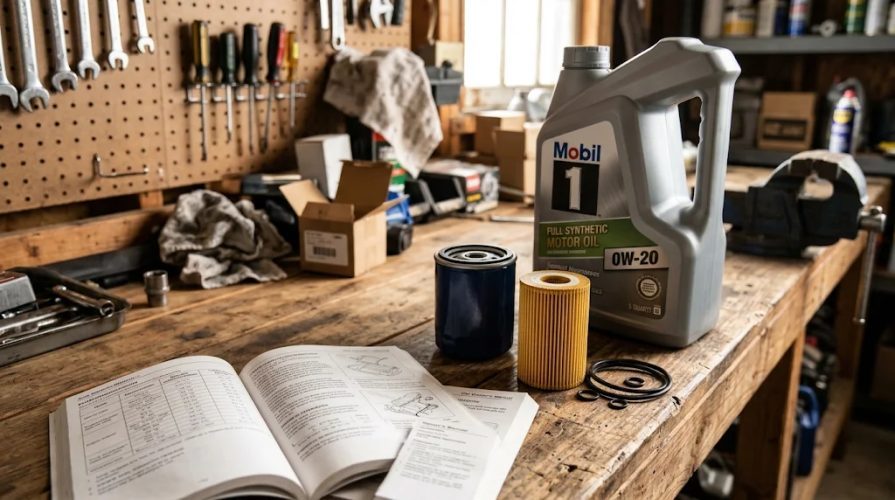
Standing in the auto parts aisle staring at forty different motor oil jugs and a wall of hundreds of filter boxes is an easy way to buy the wrong parts. Grabbing the wrong oil weight or a filter with a slightly different thread pitch can trigger a low-oil-pressure warning light, dump oil across your driveway, or jeopardize your factory powertrain warranty.
If you're asking, "What oil and filter do I need?"—whether you're buying a DIY bundle or verifying what a quick-lube technician is putting into your engine—this guide shows you how to find your exact factory specs in under a minute, plus how 2026 parts-store bundles compare against drive-thru bay coupons.
What Oil and Filter Do I Need for My Car? (4-Step Lookup)
Never guess your motor oil viscosity or filter size based on an older vehicle you used to drive. Modern engines use tight bearing clearances and variable valve timing solenoids calibrated for one specific fluid thickness. Here is the fastest way to answer what oil and filter do I need for my car with 100% accuracy:
- Check the Engine Oil Filler Cap (Takes 10 Seconds): Pop the hood and look directly at the plastic cap where oil is poured into the engine. On nearly every modern Toyota, Honda, Ford, Chevrolet, Subaru, and Hyundai, the required viscosity grade—such as
0W-20,5W-30, or0W-16—is stamped right on top of the cap. - Check the Owner's Manual "Specifications" Section: Flip to the back index of your owner's manual under "Fluid Capacities." This page gives you three critical pieces of data: exact oil viscosity for summer and winter climates, total crankcase capacity (including the filter, such as 4.8 quarts or 6.0 quarts), and the required industry certification (like API SP, ILSAC GF-6, or GM dexos1 Gen 3).
- Use a License Plate or VIN Part Finder: When looking up what oil and oil filter do I need on websites like AutoZone, O'Reilly Auto Parts, Advance Auto Parts, or RockAuto, don't just guess your engine size from a dropdown menu. Many vehicles offer two or three different engines in the same model year (for example, a 2.0L naturally aspirated vs. a 1.5L turbo). Entering your license plate or 17-digit VIN guarantees you get the exact filter part number that fits your engine block.
- Read the Part Number Off Your Current Oil Filter: If you are still unsure which filter fits, peek under the hood or beneath the front bumper at the filter currently installed on your engine. Every spin-on filter has a part number printed on the side of the metal canister (such as
PH7317,M1-110A, or57047) that any parts counter or cross-reference chart can match in seconds.
What Type of Oil and Filter Do I Need? (Synthetic vs. Blend & Filter Styles)
Once you know your viscosity numbers and part code, the next question is "what type of oil and filter do I need on the shelf?" Both motor oil and oil filters come in distinct tiers:
1. Choosing the Right Type of Motor Oil
- Full Synthetic Oil: Mandatory for almost all 2018-and-newer vehicles, turbocharged engines, and cars calling for 0W-16 or 0W-20 weight. Resists thermal breakdown, prevents low-speed pre-ignition (LSPI), and flows effortlessly on freezing winter mornings.
- High-Mileage Full Synthetic: Formulated for vehicles with over 75,000 miles on the odometer. Contains seal conditioners that restore flexibility to aging rubber crankshaft gaskets and valve stem seals to slow down minor seepage and oil consumption.
- Synthetic Blend / Conventional: Suitable for older, non-turbocharged V6 and V8 engines or drivers who strictly change their oil every 3,000 to 4,000 miles.
2. Choosing the Right Type of Oil Filter
- Spin-On Metal Canister vs. Cartridge Element: Your engine design dictates this choice. Most domestic and Asian engines use a classic metal spin-on canister that screws directly onto the block. Many European cars (BMW, VW, Audi, Mercedes), along with newer Toyota and Subaru models, use a paper or synthetic cartridge element that drops inside a permanent plastic or aluminum housing cap.
- Standard Cellulose vs. Synthetic Media Filters: If you're wondering what kind of oil and filter do I need for a 5,000-to-7,500-mile synthetic oil interval, skip the $5 economy cardboard/cellulose filter. Choose a mid-tier or synthetic-media filter (rated for 10,000+ miles) with a silicone anti-drainback valve, which prevents dry engine rattling on morning cold starts.
Cheat Sheet: Common Oil & Filter Pairings by Popular Vehicle
While you should always double-check your filler cap or VIN, here is what the most common cars and trucks on the road typically require in 2026:
| Vehicle / Engine Type | Required Oil Type & Weight | Typical Capacity (With Filter) | Filter Style |
|---|---|---|---|
| Honda Civic / CR-V / Accord (1.5T & 2.0L) | 0W-20 Full Synthetic (API SP) | 3.7 – 4.4 Quarts | Spin-On Canister (One universal Honda size fits most) |
| Toyota RAV4 / Camry / Corolla (2019–2026) | 0W-16 or 0W-8 Full Synthetic | 4.5 – 4.8 Quarts | Spin-On or Cartridge (Varies by year) |
| Ford F-150 (2.7L & 3.5L EcoBoost V6) | 5W-30 Full Synthetic (Ford WSS-M2C961-A1) | 6.0 Quarts | Top-Mount Cartridge (2.7L) or Spin-On (3.5L) |
| Chevy Silverado / Tahoe (5.3L & 6.2L V8) | 0W-20 Full Synthetic (GM dexos1 Gen 3) | 8.0 Quarts | Heavy-Duty Bottom Spin-On Canister |
| Subaru Outback / Forester / Crosstrek (2.5L) | 0W-20 Full Synthetic | 4.4 – 4.8 Quarts | Top-Mount Spin-On Canister (Right under the hood) |
DIY Oil & Filter Bundle vs. Quick-Lube Bay: Which Is Cheaper in 2026?
Now that you know what kind of oil and filter do I need, does it make more financial sense to buy a parts-store bundle or pull into a 15-minute express bay?
- DIY Retail Bundle ($36 to $45): Buying a 5-quart jug of Mobil 1, Pennzoil Platinum, or Valvoline Advanced Full Synthetic plus a matching OEM or Wix filter costs roughly $36 at Walmart or $40–$45 via monthly "Oil & Filter Specials" at AutoZone and O'Reilly. Remember to add $9 to $11 per extra quart if you drive a 6-to-8-quart pickup truck or V6 SUV.
- Drive-Thru Express Bay With a Coupon ($55 to $68): Paying walk-in menu price at a quick-lube chain will easily run $90 to $115 for full synthetic. However, using a verified $20 to $30 digital coupon drops a stay-in-your-car synthetic oil and filter change down to $55–$68—meaning you pay only about $18 extra to stay clean in the driver's seat while a tech swaps the filter, tops off your washer fluid, checks tire pressure, and recycles the old oil.
Frequently Asked Questions
What happens if I put 5W-30 in a car that asks for 0W-20?
In an emergency top-off, mixing a quart of 5W-30 into 0W-20 won't destroy your engine. However, doing a full oil change with thicker 5W-30 in a modern engine designed for 0W-20 or 0W-16 can reduce fuel economy, slow down cold-morning oil flow to the cylinder head, and trigger variable valve timing (VVT) check-engine codes.
Do quick-lube shops carry the exact oil filter my car needs?
Yes. National chains like Valvoline Instant Oil Change, Jiffy Lube, Take 5, Midas, and Firestone stock walls of both spin-on canisters and drop-in cartridge elements covering 99% of domestic, Asian, and European passenger vehicles on the road.
Save on Your Next Oil and Filter Change
Whether you're due for a 0W-20 synthetic change on a daily commuter or a 6-quart 5W-30 service on a family SUV, never pay full retail menu price. Grab a verified Take 5 oil change coupon or check active discounts for other major chains on OilChangeHack before heading to the bay to knock $20 to $30 off your total invoice.