
High-volume quick-lube facilities rely heavily on loss-leader marketing to drive bay traffic. Franchise operators frequently distribute discount oil change coupons across regional mailers and digital aggregators, lowering upfront entry barriers for price-sensitive drivers. A motorist responding to an oil change coupon $25 or an online flyer advertising a half off oil change often enters the service lane anticipating a routine, twenty-minute maintenance visit. However, fast-lube business models depend on converting low-margin rack visits into high-ticket repair orders to meet franchise margin targets.
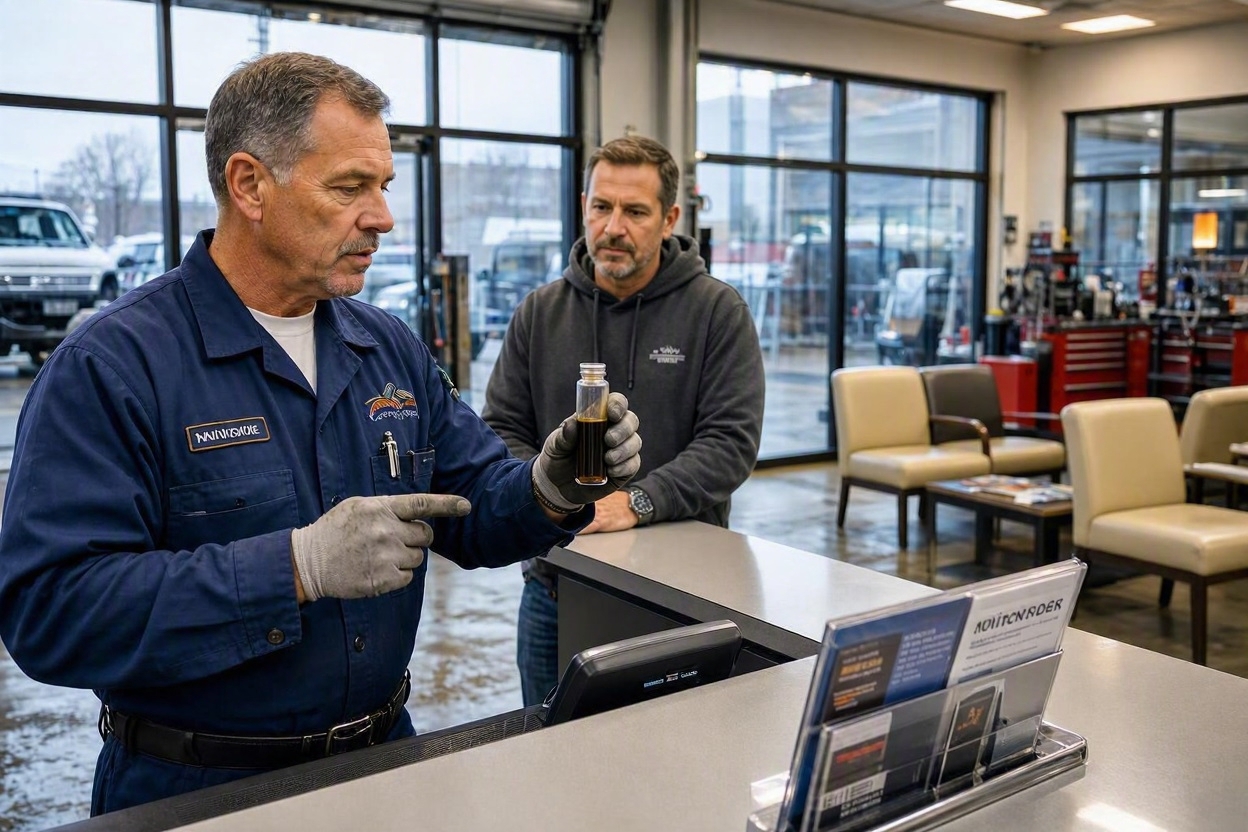
Upon presenting a printable oil change coupon at the service desk, vehicle owners are systematically guided through a multi-point inspection protocol designed to uncover additional fluid deficiencies. Service advisors frequently emerge from the pit holding a dipstick or a sample reservoir, asserting that discolored automatic transmission fluid indicates imminent mechanical failure. Understanding the operational mechanics behind the service counter—particularly the distinction between an automotive manufacturer-approved drain-and-fill procedure and an aggressive machine flush—is essential for vehicle longevity and consumer financial protection. Motorists evaluating franchise fluid exchange recommendations in high-volume customer lounges, such as those documented across Jiffy Lube service centers, must distinguish between essential hydraulic maintenance and predatory maintenance upsells.
Physical Mechanics: Gravity Drain & Fill vs. Machine Flush
Automatic transmissions are precision hydraulic mechanisms that rely on fluid to lubricate planetary gearsets, cool frictional interfaces, and transmit hydraulic line pressure through microscopic valve body passages. When addressing fluid degradation, two fundamentally different maintenance methodologies exist within modern repair bays.
The Gravity Drain and Fill Procedure
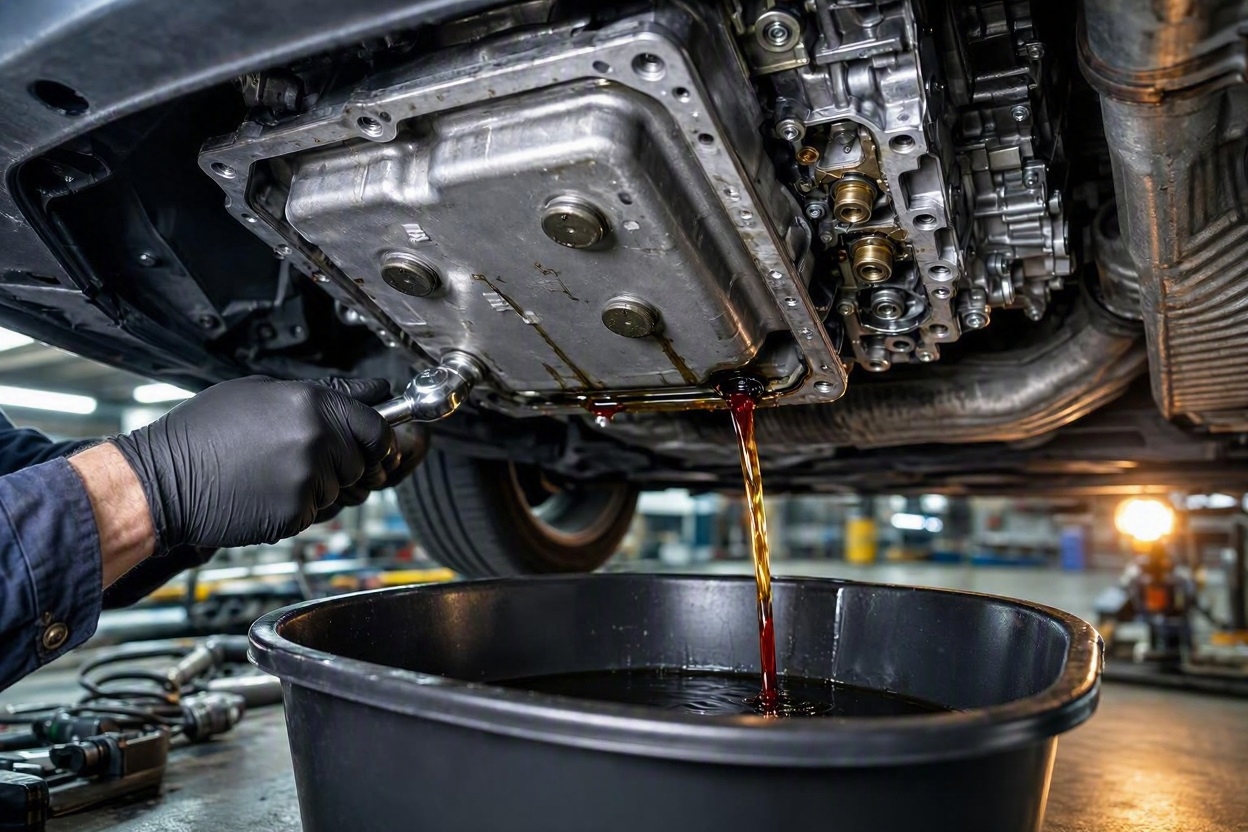
The gravity drain and fill represents the traditional, conservative maintenance standard established by automotive engineering departments. A technician raises the vehicle on a two-post lift, unbolts the transmission oil pan (or removes the dedicated drain plug on modern units), and allows exhausted fluid to evacuate under natural atmospheric pressure.
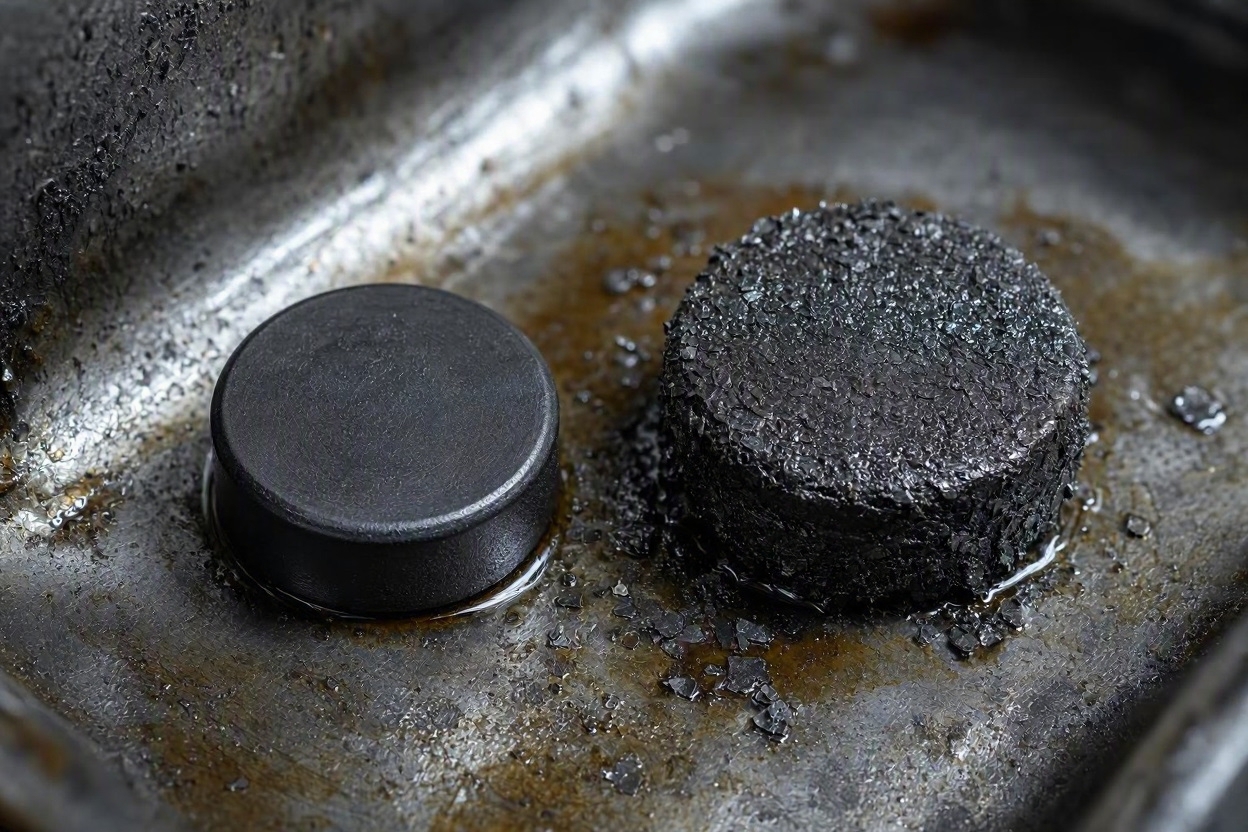
This procedure replaces approximately 40% to 50% of the transmission's total fluid capacity, typically spanning 4 to 6 quarts in a standard 10-quart system. The remainder resides within the torque converter, internal clutch drums, and hydraulic cooling circuits. Dropping the pan permits direct physical inspection of the internal collection magnets. These magnets capture ferrous metal shavings generated by normal gear and bearing wear. A complete drain-and-fill service includes cleaning these magnets, wiping sediment sludge from the pan floor, replacing the pan gasket, and discarding the primary particulate filter. Gentle gravity replenishment introduces fresh fluid without altering internal line pressures.
The High-Pressure Machine Flush (Fluid Exchanger)
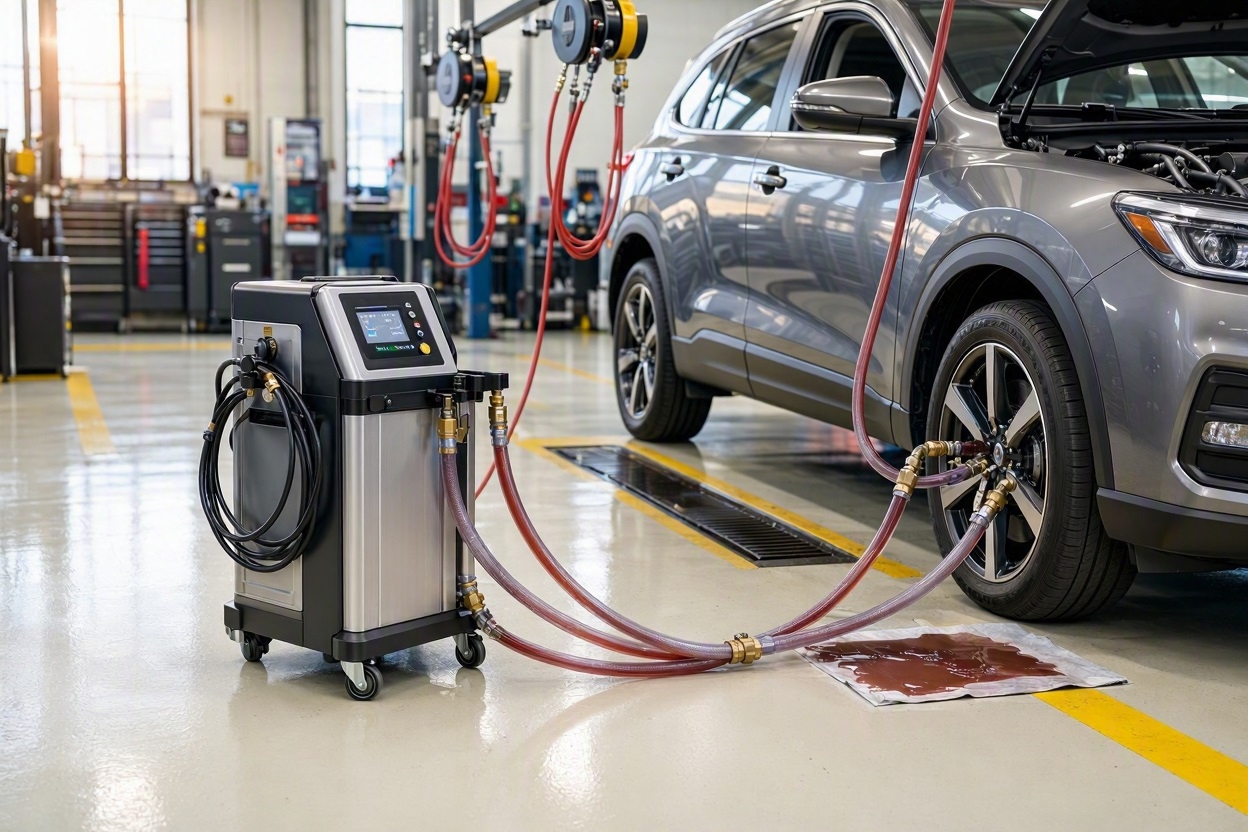
Quick-lube chains heavily promote the pressurized machine flush, often executed using fluid exchange equipment such as T-Tech or pneumatic exchange carts. Technicians tap directly into the transmission cooler lines running to the radiator or auxiliary thermal exchanger. The flush machine forces 12 to 22 quarts of fluid through the transmission under external hydraulic pressure or by utilizing the transmission’s internal pump against machine backpressure.
While marketing materials claim a flush replaces 100% of contaminated fluid, quick-lube facilities rarely remove the transmission pan during this service. As a result, metallic shavings remain glued to saturated magnets, bottom-pan sludge remains undisturbed until loosened by turbulent flow, and the internal transmission filter is never changed. Technicians running high-speed operations across Take 5 Oil Change or similar drive-thru layouts face strict time boundaries, incentivizing fast cooler-line flushes over time-consuming pan drops.
| Service Dimension | Gravity Drain & Fill | Machine Flush (Fluid Exchanger) |
|---|---|---|
| Fluid Volume Swapped | 40% – 50% (4 to 6 quarts) | 90% – 100% (12 to 22 quarts cycled) |
| Pan Removal & Cleaning | Yes; pan is wiped clear of sludge | Rarely; pan remains bolted to case |
| Magnet Inspection | Yes; ferrous wear particles removed | No; debris remains on internal magnets |
| Internal Filter Replacement | Yes; media filter replaced | No; old filter left inside transmission |
| Hydraulic Risk Factor | Extremely low; zero pressure spike | High; risks valve body solenoid fouling |
| Average National Cost | $120 – $180 | $175 – $350+ |
The 75,000-Mile Transmission Trap
The most catastrophic mechanical outcomes occur when pressurized flushes are applied to transmissions with over 75,000 miles that have never received scheduled maintenance. Automotive repair shops routinely encounter vehicles towed in immediately following a quick-lube flush, exhibiting severe gear slip, erratic shifting, or total loss of drive engagement.
The Clutch Friction Suspension Phenomenon
As mileage accumulates, internal clutch plates composed of paper, cellulose, and phenolic resin materials shed microscopic friction particles into the oil. Over time, this debris forms a semi-stable suspension within the aged fluid. In worn clutch packs where the friction linings have deteriorated, this suspended clutch particulate provides the critical dynamic friction coefficient necessary for clutch bands and plates to achieve torque-holding capacity.
When an exchange machine completely strips this aged, grit-carrying fluid and introduces a high-detergent fresh formulation, clutch pack clearances expand. Without suspended friction particles or friction modifiers calibrated to worn friction material, aged clutch packs experience immediate, uncontrolled slippage.
Hydraulic Valve Body Contamination and Failure Cascade
Modern automatic transmissions shift gears via an intricate electro-hydraulic assembly known as the mechatronic unit or valve body. Inside, variable-bleed solenoids and pressure regulators actuate polished steel valves within aluminum bores manufactured to tolerances measured in single-digit microns.
The mechanical failure cascade follows a predictable progression when high-pressure equipment is connected to an aged transmission:
- High-pressure backflushing surges turbulent fluid through cooler lines and internal passages, dislodging hardened varnish, oxidized friction paste, and settled bottom-pan sludge.
- Mobilized particulate flows directly into the fine channels of the valve body rather than settling harmlessly on pan magnets.
- Suspended metallic debris and hardened varnish enter solenoid bores, lodging between solenoid plungers and aluminum valve sleeves.
- Scored valve bores and seized solenoid plungers prevent the valve body from regulating hydraulic line pressure.
- Severe pressure drops starve clutch apply circuits, leading to immediate clutch slippage, harsh shifting flares, limp-mode activation, and diagnostic trouble codes such as P0730 or P0750.
Original equipment manufacturers explicitly recognize this hazard. American Honda Motor Co. issued dedicated service bulletins (including TSB 16-061 and TSB 23-073) formally warning against using aftermarket machine flush systems. Honda documented that pressurized flush equipment damages internal seals, forces debris into unserviceable filters, and overpressurizes internal circuits, mandating that technicians perform solely gravity-based drain-and-fill procedures using genuine OEM fluids.
Debunking the "Lifetime Fluid" Myth
A major contributor to consumer confusion is the prevalence of "lifetime fill" or "sealed for life" claims published in contemporary vehicle owner manuals. Transmissions such as the ZF 8HP (equipped across BMW, Audi, Ram, and Stellantis vehicles), Aisin 8-speed units (found in Toyota, Lexus, and Volvo), and Ford/General Motors 10-speed platforms (10R80 and 10L90) are frequently marketed as maintenance-free.
Engineering data reveals that the term "lifetime" does not denote indefinite operational health. For automobile manufacturers, "lifetime" corresponds to the mechanical warranty window or the anticipated initial commercial ownership cycle—typically 60,000 to 100,000 miles. Transmission failure occurring beyond 100,000 miles is treated as expected vehicle retirement, shifting replacement costs entirely onto consumer shoulders.
Transmission engineering firms contradict vehicle marketing divisions. ZF Friedrichshafen AG, the engineering entity that designs and manufactures the 8HP transmission, explicitly specifies fluid and filter replacement intervals every 50,000 to 75,000 miles (or 8 years). Under severe duty cycles—such as stop-and-go commuting, high-temperature climates, performance operation, or regular trailering—ZF recommends replacement at 40,000 miles.
| Transmission Unit | Automaker Claim | Component Manufacturer Interval | Documented Failure Mechanism |
|---|---|---|---|
| ZF 8HP Series (BMW / Stellantis) | "Lifetime Fill / No Service" | 50,000 – 75,000 miles / 8 years | Mechatronic solenoid sticking, pan warpage |
| Aisin 8-Speed (Toyota / Lexus) | Lifetime under normal use | 60,000 miles under severe duty | Valve body bore wear, torque converter clutch slip |
| GM 8L90 / 8L45 (Silverado / Corvette) | Extended maintenance schedule | TSB 18-NA-355 fluid exchange required | Hygroscopic additive failure causing severe shudder |
| Ford / GM 10-Speed (10R80 / 10L90) | 150,000-mile interval | 50,000 – 60,000 miles real-world | CDF clutch cylinder sleeve movement, fluid shear |
The Thermal Degradation Threshold
Automatic transmission fluid undergoes severe mechanical shear and thermal breakdown during normal operation. Standard automatic transmission operating temperatures hover between 175°F and 195°F. Once sustained internal operating temperatures surpass 200°F (93°C), thermal oxidation accelerates rapidly.
Based on chemical kinetic degradation rates, every 20°F increase in bulk fluid temperature above 175°F cuts the functional lifespan of automatic transmission fluid by half. Mechanical shear stress induced by high-pressure planetary gear meshing simultaneously shears long-chain Viscosity Index Improver (VII) polymer chains. The resulting permanent viscosity loss prevents the fluid from maintaining adequate hydrodynamic film thickness, triggering accelerated metal-to-metal contact across planetary pins and bearing surfaces.
| Operating Temperature | Thermal Status | Expected Useful Fluid Lifespan | Primary Chemical Failure Mechanism |
|---|---|---|---|
| 175°F (79°C) | Optimal Range | 80,000 – 100,000 miles | Baseline slow additive depletion |
| 195°F (91°C) | Moderate Stress | 50,000 miles | Initial oxidation of anti-wear packages |
| 215°F (102°C) | High Thermal Load | 25,000 miles | Friction modifier breakdown, polymer shear |
| 235°F (113°C)+ | Critical Breakdown | Under 12,000 miles | Carbonaceous varnish formation, seal hardening |
The Universal Fluid Bait-and-Switch
When motorists consent to a quick-lube transmission flush, they assume the bay installs fluid formulated to factory engineering tolerances. Quick-lube supply chains, however, make stocking dozens of application-specific OEM fluids economically impractical. Modern drivetrains demand highly specialized, chemically distinct formulations:
- Ford vehicles require Mercon LV or Mercon ULV (Ultra-Low Viscosity).
- General Motors units require Dexron VI or Mobil 1 Synthetic LV ATF HP.
- Toyota and Lexus gearboxes demand Toyota ATF WS (World Standard).
- Honda and Acura drivetrains specify Honda Genuine ATF-DW1.
- ZF transmissions require dedicated ZF Lifeguard Fluid 8.
To circumvent inventory carrying costs, franchise facilities routinely maintain a single bulk drum of generic, low-cost multi-vehicle automatic transmission fluid. When servicing a vehicle requiring proprietary friction dynamics, technicians pour an aftermarket chemical conversion additive bottle into the flush machine. These aftermarket supplement bottles claim to instantly modify generic base stock to match Toyota WS or Honda DW-1 standards.
From a tribological perspective, chemical supplement bottles cannot alter the fundamental base-oil viscosity, shear stability, or dynamic-to-static friction curves engineered into specialized factory fluids. General Motors documented in Technical Service Bulletin 18-NA-355 that torque converter clutch shudder in 8L90 and 8L45 transmissions stemmed directly from moisture absorption and friction modifier degradation in early factory fills. GM resolved this issue only through an exhaustive flush procedure requiring 16 to 24 quarts of an engineered, low-viscosity synthetic fluid (Mobil 1 LV ATF HP). Installing generic bulk fluid spiked with an aftermarket additive bottle induces torque converter clutch slip, erratic clutch modulation, and long-term friction plate glazing.
When vehicle owners require comprehensive transmission diagnostics or fluid maintenance, consulting dedicated drivetrain facilities such as certified independent transmission specialists or Midas service locations provides greater assurance that specific factory fluid specifications are observed.
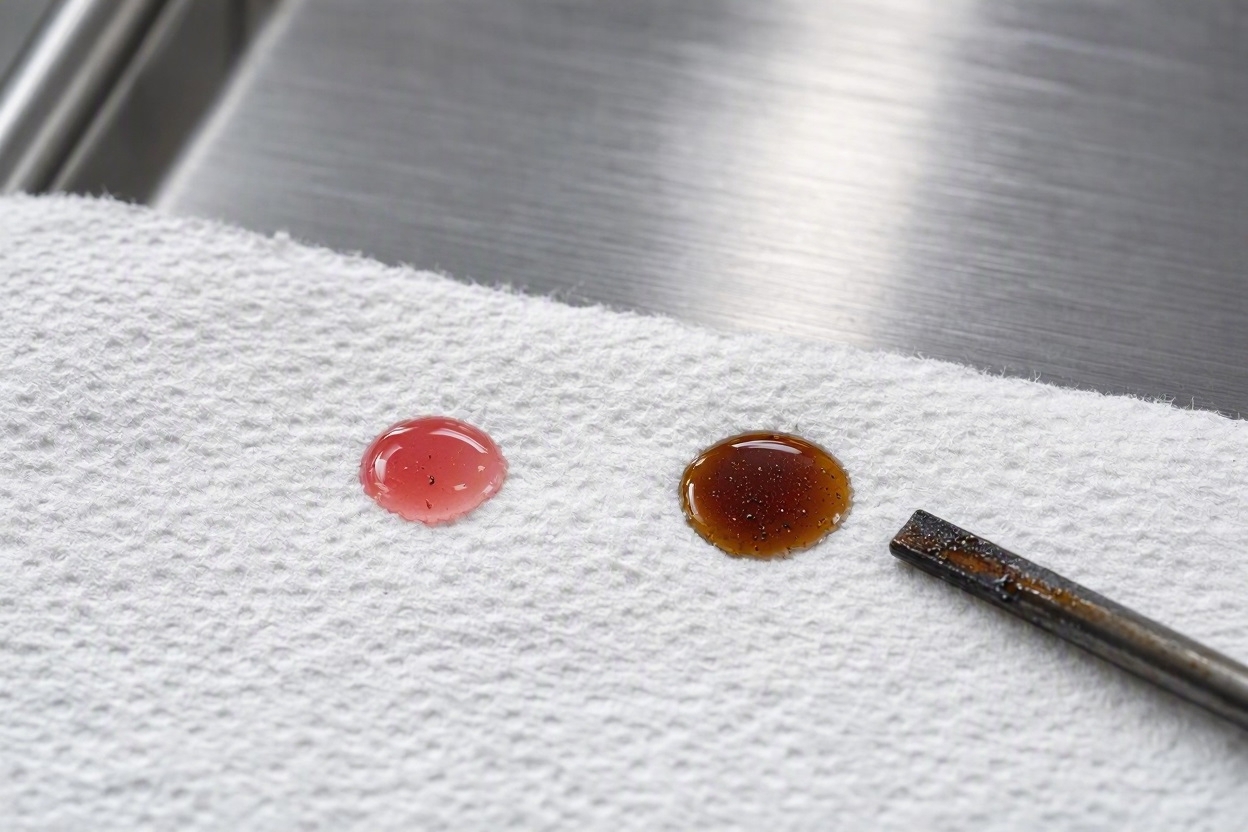
Deceptive Bay Inspections: The Paper Towel Drop Test
The most widespread sales tactic utilized in drive-thru maintenance facilities involves the white paper towel test. A technician places a droplet of fresh, translucent red ATF next to a drop pulled from the customer's transmission dipstick. Pointing to the dark brown coloration of the used fluid, the service advisor claims the fluid is burnt and warns that immediate flush intervention is required to avoid gearbox destruction.
This demonstration exploits visual psychology rather than chemical reality. Modern automatic transmission fluids contain organic red dyes added purely for factory leak detection, distinguishing ATF from engine oil or coolant. Exposure to normal operating temperatures causes organic red dyes to dissipate and darken into deep amber or light brown within 10,000 to 15,000 miles of driving.
Fluid discoloration is a standard physical characteristic of heat cycling, not an accurate marker of lubrication failure. True fluid degradation is detected through scent and laboratory spectrographic analysis. Highly oxidized transmission fluid smells distinctly acrid, pungent, and scorched, resembling burnt electrical wiring. If used fluid is dark brown but smells neutral or sweet, the additive package remains functional. Drivers seeking to protect maintenance budgets should review documented guides exposing deceptive paper towel inspection tactics to avoid paying for unnecessary fluid replacements.
The Coupon Conversion Engine
The commercial architecture of modern quick-lube facilities relies on fine-print coupon structures. Franchise operations analyze drive-thru throughput based on average ticket size. When an oil change coupon is redeemed, bay technicians are trained to execute systematic fluid and filter upsell gauntlets.
Even when an informed motorist presents a synthetic oil change coupon, franchise service advisors leverage the rack time to examine auxiliary fluid reservoirs. Consumers seeking to control costs often review resources on navigating discount coupon fine-print traps, as bay inspections routinely target transmission, transfer case, and cooling systems to recover margins conceded on the engine oil. Motorists who search for an oil change near me coupon typically prioritize local convenience, unaware that high turnover rates incentivize technicians to propose high-margin machine flushes regardless of vehicle mileage or service history. Furthermore, a consumer presenting a coupon for full synthetic oil change frequently discovers that the modest coupon discount is wiped out by an unprompted $200 transmission flush recommendation.
Legal Rights and The Service Bay Counter Script
When service writers push transmission flushes under the threat of voided warranties, automotive consumers possess substantial federal legal protections.
The Magnuson-Moss Warranty Act (15 U.S.C. § 2301)
The federal Magnuson-Moss Warranty Act governs consumer product warranties across the United States. Under Section 102(c) of the Act (15 U.S.C. § 2302(c)), commonly referred to as the anti-tying provision, it is illegal for a manufacturer, franchised dealer, or service center to condition a warranty on the customer using a specific brand of article or non-OEM chemical service, unless provided free of charge under warranty.
Dealership service departments and franchise lube centers cannot void a powertrain warranty simply because a vehicle owner refuses a chemical flush or elects to have routine drain-and-fill services executed by an independent mechanic. To deny warranty coverage, the automotive manufacturer or dealership carries the legal burden of proof to demonstrate that a specific fluid or procedure directly caused internal mechanical failure. Given that manufacturers such as Honda actively publish technical service bulletins forbidding external flush machines, refusing a quick-lube machine flush protects warranty compliance rather than compromises it.
The Verbatim Counter Script
When confronted by an aggressive service writer in the pit or lounge asserting that dark transmission fluid requires an immediate flush, motorists should deliver the following precise counter statement:
"I decline the transmission flush service today. My vehicle manufacturer explicitly warns against using high-pressure cooler-line flush machines and non-OEM universal additive blends. Under the Magnuson-Moss Warranty Act, declining this unapproved aftermarket flush does not affect my factory powertrain warranty. Please note on my final work order that I requested the transmission fluid be left alone, complete solely the basic engine oil and filter change, and finalize my invoice."
This script establishes technical knowledge, references governing federal consumer law, and eliminates sales pressure by removing negotiating ambiguity.
Drivetrain Maintenance Decision Framework
To protect automotive drivetrains and household budgets, motorists should consult the following mechanical framework prior to commissioning transmission service:
| Odometer / Transmission Condition | Recommended Procedure | Actionable Protocol |
|---|---|---|
| 0 to 60,000 Miles (Normal Operation) | Preventative Maintenance | Perform an OEM-spec gravity drain and fill. Drop pan, inspect magnet collection, and replace the filter. |
| 60,000 to 100,000 Miles (Never Serviced) | Cautious Maintenance | Execute a gravity drain and fill only. Strictly avoid high-pressure machine flushes. Confirm genuine OEM-specified fluid is installed. |
| Over 100,000 Miles (Clean Fluid / Shifts Well) | Inspection & Evaluation | Inspect fluid condition. If clean, execute a single gravity drain and fill. Repeat 5,000 miles later if staged fluid dilution is desired. |
| Over 100,000 Miles (Black Fluid / Slipping Gears) | Do Not Service | Leave existing fluid undisturbed. Mobilizing dislodged debris or diluting suspended friction material will cause immediate clutch failure. Prepare for mechanical rebuild. |
| Active Shifting Shudder / Gear Slippage | Professional Diagnostics | Tow or drive vehicle to a specialized transmission rebuilder or dealer. Never install generic quick-lube chemical flushes to fix mechanical slipping. |