
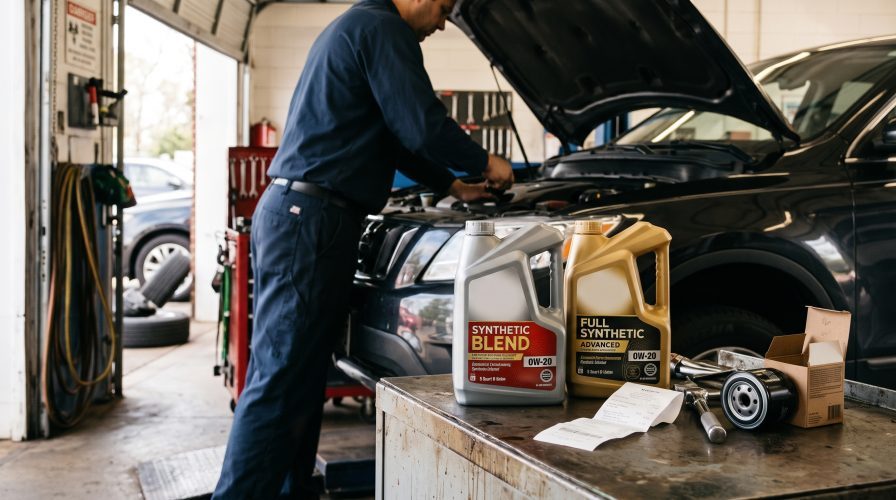
Pull into any drive-thru oil change bay in 2026, look up at the menu board, and you're hit with an immediate $35 to $45 price jump between "Synthetic Blend" and "Full Synthetic." While the technician scans your VIN at the window, they'll almost always push you toward the $99.99 full synthetic tier—or pitch an even pricier High Mileage package once they spot 75,000 miles on your dashboard.
Here is what the quick-lube chains won't tell you at the register: for the shop, upgrading you from a blend to full synthetic is pure profit margin. Wholesale bulk synthetic oil only costs the shop about $6 to $9 more per five-quart fill than a blend, yet they mark up the service by $40 on your invoice.
Does your engine actually need the expensive stuff, or are you flushing money down the drain plug? Here is the real breakdown of the synthetic blend vs. full synthetic price difference, which engines will suffer catastrophic damage on a cheap blend, and how to use national lube-shop coupons so you pay blend prices for top-tier synthetic protection.
2026 Oil Tier Comparison: Cost, Interval, and Real Cost Per Mile
| Oil Type | Average Quick-Lube Menu Price | Safe Change Interval | Real Cost Per 1,000 Miles | Who Should Buy It |
|---|---|---|---|---|
| Conventional Oil | $39.99 – $49.99 | 3,000 – 4,000 miles | ~$12.50 | Pre-2010 naturally aspirated cars, classic weekend cruisers, or oil-burners |
| Synthetic Blend | $59.99 – $69.99 | 5,000 miles | ~$13.00 | Older V6/V8 trucks and non-turbo engines calling for 5W-20 or 5W-30 |
| Full Synthetic | $89.99 – $109.99 | 7,500 miles | ~$12.60 (Or ~$9.50 with coupon) | All modern 0W-20 / 0W-16 engines, all turbocharged engines, and extreme climates |
| High Mileage (Blend or Full Syn) | $74.99 – $114.99 | 5,000 – 7,500 miles | ~$13.50 | Engines over 75,000 miles with minor valve cover or rear main seal seepage |
Synthetic Blend vs. Full Synthetic Price Difference: Why the Math Tricks You
On the surface, paying $64.99 for a synthetic blend instead of $99.99 for full synthetic looks like an easy $35 savings. That's how shops hook budget-conscious drivers. But you have to look at the chemistry—and the calendar—to see why that "discount" is often a mirage.
First, the industry secret about Synthetic Blend: there is no federal law regulating how much synthetic base oil has to be inside a bottle labeled "Synthetic Blend." A refiner can mix 85% cheap conventional mineral oil with just 15% synthetic base stock, slap "Synthetic Blend" on the drum, and charge you $25 more than a basic conventional oil change.
Second, compare the mileage math over 15,000 miles of driving:
- The Synthetic Blend Route: Because a blend breaks down faster under heat, you have to change it every 5,000 miles. Three visits a year at $65 a pop (plus $7 in shop fees each time) costs you $216 per year—plus three hours of your life sitting in a service bay.
- The Full Synthetic Route (With a Coupon): Full synthetic easily lasts 7,500 miles between changes without shearing down. That means only two visits per year. Grab a $20 off coupon from our Valvoline coupons page or our Jiffy Lube discount codes, and a $95 full synthetic service drops to $75. Two visits a year costs you $150 total. You put superior oil in your crankcase and still come out $66 ahead.
When You MUST Pay for Full Synthetic (And When a Blend Is Fine)
Before you ask the tech for the cheaper blend, pop your hood and read the plastic oil filler cap. In 2026, two non-negotiable mechanical rules dictate whether you can safely downgrade:
1. Your Oil Cap Says 0W-20 or 0W-16
If you drive almost any Honda, Toyota, Subaru, Mazda, or Nissan built in the last decade, your engine requires 0W-20 or ultra-thin 0W-16 motor oil. You cannot make a 0W-20 or 0W-16 viscosity oil out of conventional mineral oil—it physically requires synthetic base stocks to flow at sub-zero temperatures without turning into molasses. If your cap says 0W-20, full synthetic isn't an upsell; it's a factory requirement.
2. Your Engine Has a Turbocharger (EcoBoost, CR-V 1.5T, Chevy 1.5T/2.7T)
Automakers downsized from big V6 engines to tiny 1.5-liter and 2.0-liter turbocharged four-cylinders to pass fuel-economy rules. A turbocharger spins at up to 200,000 RPM and uses your engine oil to cool its bearings, which reach scorching temperatures over 400°F. When you shut your hot engine off in a parking lot, conventional or blend oil sitting inside that turbo housing literally bakes into hard carbon grit—a process mechanics call "oil coking." Over time, that grit starves the turbo bearing and hands you a $2,800 turbo replacement bill. Turbocharged engines need 100% full synthetic oil, period.
When a Synthetic Blend is totally safe: If you drive an older, naturally aspirated (non-turbo) vehicle that calls for 5W-20 or 5W-30—like a 2014 Ford F-150 5.0L V8, an older Dodge Grand Caravan 3.6L V6, or a older Chevy Tahoe—and you faithfully change your oil every 5,000 miles, a synthetic blend will keep that engine running to 250,000 miles without breaking a sweat.
Is High Mileage Oil Worth It at 75,000 Miles?
The moment your odometer crosses 75,000 miles, every point-of-sale computer at Valvoline, Take 5, and Jiffy Lube flashes an alert telling the tech to pitch you "High Mileage" oil (like Valvoline MaxLife or Pennzoil High Mileage) for an extra $10 to $15.
So, is high mileage oil worth it at 75,000 miles, or is 75,000 just an arbitrary marketing number? That 75,000-mile threshold was invented by oil marketers in the late 1990s. On a modern 2020-or-newer vehicle, 75,000 miles is barely broken in. However, High Mileage oil does contain two legitimate chemical differences:
- Seal Conditioners (Ester additives): As rubber crankshaft seals, valve stem seals, and oil pan gaskets age past 8 to 10 years, they dry out and shrink. High mileage oil contains chemical conditioners that cause older elastomer seals to swell slightly and regain pliability, which can slow down or stop minor driveway oil drips.
- Slightly Thicker Viscosity & Anti-Wear Boosters: High mileage oils are blended toward the thicker upper limit of their weight grade (along with extra phosphorus/zinc anti-wear additives) to reduce oil consumption past worn piston rings.
The Verdict: If your engine is at 80,000 miles, bone-dry underneath, and doesn't burn a drop of oil between changes, skip the High Mileage upcharge and stick with standard full synthetic. Actually introducing aggressive seal-swelling chemicals too early on healthy factory seals is pointless. Only switch to High Mileage oil if you spot wet oil seepage around your valve cover gasket, smell burning oil on the exhaust manifold, or notice your dipstick dropping half a quart between changes.
Insider Pro-Tip (Can You Switch Back From Synthetic to Conventional Oil?): One of the oldest barbershop myths in American car culture is that once you put synthetic oil in your engine, switching back to a synthetic blend or conventional oil will "shock the gaskets" and cause leaks. That is 100% false. Modern conventional, synthetic blend, and full synthetic oils meet the exact same API SP compatibility standards and can be mixed or alternated at any time without harming your engine—provided your owner's manual allows the viscosity grade (such as 5W-30). If you put full synthetic in your older truck for a freezing January road trip and want to switch back to a cheaper synthetic blend in July, go right ahead.
How to Get a Full Synthetic Oil Change for the Price of a Blend
You should never pay $100+ out the door for five quarts of full synthetic oil. Before driving to the shop, use these three moves to force the price of a full synthetic swap down into the $55 to $70 range:
- Use Full-Service Loss Leaders (Save $25–$35): Quick-lube drive-thrus charge a premium for speed. If you have 45 minutes to spare, book online with a tire-and-brake chain. Check our Midas oil change coupons or Firestone Complete Auto Care deals—both chains routinely run $54.99 to $64.99 Full Synthetic specials (often including a free tire rotation) just to get your car onto their alignment racks.
- Bring a High-Tier Digital Barcode to Drive-Thrus (Save $15–$25): Lube chains structure their coupons so the biggest dollar discounts apply exclusively to full synthetic tiers. A coupon might only take $7 off a conventional change, but it will slash $20 to $25 off a full synthetic service. Pull up a barcode from our Take 5 promo codes page before the tech writes up your ticket, and the price gap between a blend and full synthetic shrinks to less than $12.
- The Walmart Auto Care Bypass (Save $40): If you don't want to haggle with coupons at all, Walmart Auto Care Centers charge a flat $48.88 to $54.88 for a Quaker State, Castrol, or Mobil 1 Full Synthetic oil change every day of the week—roughly $15 cheaper than what drive-thru chains charge for a lower-grade synthetic blend.