
In my two decades spinning wrenches, working everywhere from independent dirty-floor garages to the high-speed service bays of major franchise dealerships, I’ve seen every trick in the automotive playbook. Just last week, a customer rolled in with a 2021 Chevy Silverado. He proudly flashed a digital coupon for a "$24.99 Oil Change" on his phone, expecting a cheap, easy trip. Thirty minutes later, he was staring at an invoice for $118, his face red with shock and anger. He didn't read the fine print, and he fell victim to a highly optimized, heavily engineered sales funnel. Don't get me wrong—coupons are fantastic, but only if you know exactly how the quick-lube game is played. Today, I'm pulling back the curtain to give you the insider secrets and show you how to protect your wallet.
The "Loss Leader" Concept
You’ve seen the massive roadside banners for chains like Jiffy Lube, Valvoline, Take 5, and Midas. They bombard your inbox and social media feeds with offers for $20 or $30 off an oil change. But why? The hidden truth is that they lose money—or barely break even—on the oil change itself. In the quick-lube industry, the average profit margin on a basic oil change is a razor-thin 10% to 20%. Once they pay for the wholesale motor oil, the filter, the lube technician's hourly wage, and the massive overhead of a high-traffic real estate location, that $25 coupon puts the shop in the red.
So, how do these massive franchises survive? They utilize a retail strategy called the "loss leader." The heavily discounted oil change is nothing more than bait. The true objective of these shops is throughput: getting your car onto the lift to execute a lightning-fast, 15-minute standardized inspection. They use the core service simply to open an "Average Repair Order" (ARO) in their computer system and bombard you with highly profitable extras. Your car is a captive audience, and the discounted oil is just the price of admission.
The Fine Print Traps
The success of this loss-leader model relies entirely on the disclaimers hidden in the microscopic text at the bottom of the promotional graphic. These fine print traps routinely invalidate the expected savings for the average driver.
The 5-Quart Limit
The most devastating trap is the capacity limit. Almost universally, these offers explicitly state they include "up to 5 quarts of motor oil". Decades ago, five quarts was the standard capacity for your average mid-sized passenger sedan. But today’s modern SUVs and trucks are significantly thirstier. For instance, a 2014 or newer Chevy Silverado equipped with a 5.3L EcoTec3 V8 demands a full 8 quarts of oil. A modern Ford F-150 with a 3.5L EcoBoost engine takes 6 quarts.
When your engine goes over that 5-quart threshold, you enter the upcharge zone. Shops routinely charge a massive premium—ranging from $15 to $23 for each additional quart of synthetic oil. That $25 coupon quickly gets eaten alive by $45 to $69 in hidden fluid charges before a wrench even touches your oil pan.
| Vehicle Model | Engine Type | Total Oil Capacity | Extra Quarts Billed | Estimated Shop Upcharge |
|---|---|---|---|---|
| Chevrolet Silverado 1500 | 5.3L V8 | 8.0 Quarts | 3 Quarts | $45 - $69 |
| Ford F-150 | 3.5L EcoBoost | 6.0 Quarts | 1 Quart | $15 - $23 |
| Toyota RAV4 | 2.5L 4-Cylinder | 4.5 Quarts | 0 Quarts | $0 (Covered by Coupon) |
Disposal Fees & Shop Supplies
Next up on your inflated invoice are the administrative markups. You’ll frequently see line items for "Shop Supplies" and "Hazardous Materials Fees." Shop supplies cover incidentals like heavy-duty rags, brake cleaner, and protective fender covers, and they are usually calculated automatically by the software as a flat 5% to 10% of your total service bill.
Hazardous waste disposal fees cover the regulatory costs of safely storing and recycling your old oil and used filters. Depending on the state and the franchise, this is typically applied as a flat-rate fee. These environmental and operational surcharges are almost never waived and are explicitly excluded from the coupon’s discount structure. They just silently inflate the final total.
Conventional vs. Synthetic Bait-and-Switch
Here’s where the industry gets deeply technical. That aggressively advertised "$25 Oil Change" is almost always for conventional motor oil. However, if you drive a vehicle manufactured in the last five to eight years, your car likely can't even use conventional oil. Modern Turbocharged Gasoline Direct Injection (TGDI) engines are highly susceptible to a catastrophic phenomenon called Low-Speed Pre-Ignition (LSPI). LSPI is an abnormal combustion event triggered by high levels of calcium-based detergents found in older oils, creating massive pressure spikes that can literally shatter piston rings and crack engine blocks.
To prevent engines from destroying themselves, the industry introduced strict API SP and ILSAC GF-6 oil standards, which use advanced, magnesium-rich full-synthetic formulations. So, when you pull into a bay with a modern Honda or Toyota that strictly requires a 0W-16 or 0W-20 synthetic grade, the shop legally and ethically must perform a "forced upgrade." Just like that, your $25 conventional coupon morphs into an $80 to $100 full-synthetic ticket.
Bypass In-Bay Markup with Verified Digital Discounts
Never pay standard menu board prices for required full synthetic fluids. Lock in verified promotional savings by claiming an active valvoline oil change coupon 50 percent off directly from your phone before pulling onto the lift.
The Upsell Gauntlet
Once your vehicle is secured over the pit, the real money-making machine powers up. Modern quick-lube shops use advanced Point-of-Sale (POS) software (like Droptop or Garage360) that scans your license plate or VIN the second you drive onto the lot. This instantly populates a digital checklist of OEM fluid capacities and recommended services based on your exact mileage. The service advisor knows you need an upsell before you even roll down your window.
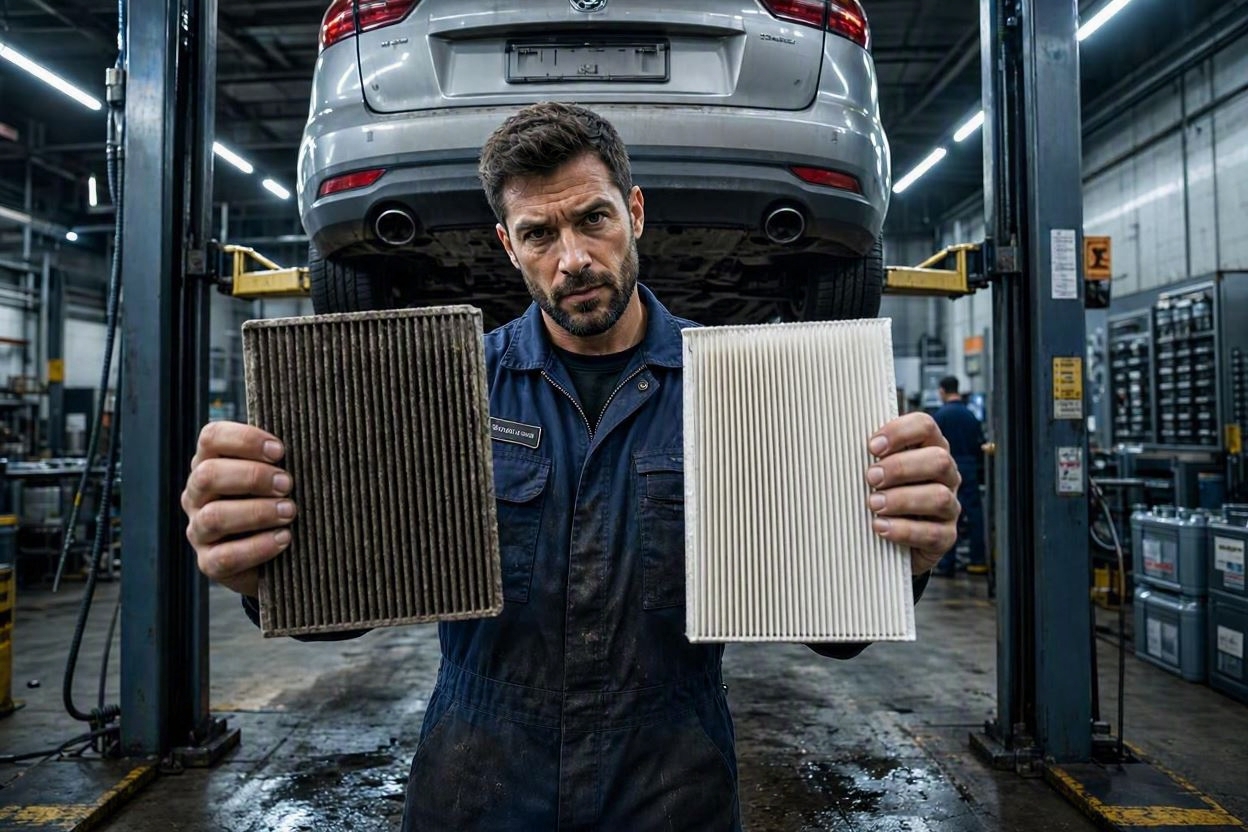
You are now in the "upsell gauntlet." Service advisors and lube technicians are highly motivated to push these extras because many operate on "spiff" programs—earning direct commissions or bonuses for every add-on they manage to sell you. They will dramatically present you with a dirty cabin air filter pulled from behind your glovebox or tell you your coolant looks degraded. The profit margins on these items are astronomical:
- Cabin Air Filters: A filter that costs the shop $25 wholesale is easily sold to you for $60.
- Wiper Blades: Wipers that cost $15 a pair wholesale are retailed for $30 to $55.
- Coolant Flushes: A basic coolant flush utilizing $25 worth of fluid can retail for an incredible $95 to $160.
To survive, you must politely but firmly decline. Check your owner's manual for actual service intervals, and buy your own filters and wipers at the local auto parts store. You can install them yourself in your driveway in under five minutes.
How to Properly "Stack" or "Bundle" Deals
While most corporate disclaimers explicitly prevent you from physically stacking multiple dollar-off coupons on a single visit, you can still maximize your value through strategic bundling. If you know your modern engine locks you into a higher-priced full-synthetic oil change, you actually hold some leverage as a premium-ticket customer.
My pro-tip is to ask for complementary services that can be easily authorized by a service manager or are sometimes quietly included in premium packages. For instance, demand a complimentary multi-point inspection, a free battery health test, or even a heavily discounted tire rotation while the vehicle is already in the bay. By forcing the shop to perform additional, labor-intensive preventative maintenance at no extra cost, you are extracting maximum labor value out of your visit, successfully offsetting the high profit margins of the synthetic oil change.
Compare Deals Across Nationwide Service Centers
Review regional rates and dodge counter fees by exploring verified oil change coupon specials across all major automotive repair chains.
Browse Verified OffersConclusion & Call to Action
At the end of the day, quick-lube shops provide a necessary and incredibly convenient service, but you cannot afford to go in blind. The discounted oil change is a fantastic tool for maintaining your vehicle on a budget, provided you play the game by their rules. Never roll up to a service bay without a digital coupon queued up on your phone, and always mentally calculate the 5-quart limit and mandatory disposal fees before you agree to the price.
Above all, hold your ground when the high-pressure upsell gauntlet begins. Armed with this knowledge, you can finally beat the lube shop at its own game. Keep your engine running smooth, verify your crankcase capacity before visiting, and make sure your digital promotional barcode is scanned before the work order is drafted so you walk out with the savings you actually planned for.