

Just yesterday morning, a customer rolled up to the drive-thru bay in a clean 2020 Ford F-150. He had that relaxed, confident posture of someone who thought he had the entire system figured out. He tapped his smartphone screen, showing the lube technician an advertised "$39.99 Special" voucher. He figured he would sit in his truck for fifteen minutes, check a few sports scores, hand over a fifty-dollar bill, and drive away with change to spare.
Twenty minutes later, when the service advisor handed him the digital tablet to approve the final invoice, his jaw dropped. The total staring back at him was $124.60. He looked at the advisor, his face turning bright red: "How in the world does a forty-dollar promotional offer turn into a hundred and twenty-five bucks?"
In all my years busting knuckles in independent garages, maintaining my own fleet vans, and tracking how major quick-lube chains operate behind the scenes, I have seen this exact scene play out hundreds of times. Drivers pull into the lot asking a simple question: how much is an oil change supposed to cost? But what you see plastered on roadside banners rarely matches what prints out at the register. Below, we break down current oil change prices, reveal why a full service oil change gets so aggressively inflated, and show you how to lock in the cheapest synthetic oil change possible without compromising engine health.
The Menu Board Reality: Comparing Oil Change Rates by Fluid Type
Pull up to any bay door or step into a waiting lounge, and you will find retail packages split into three primary brackets. Behind the counter, however, service writers view these tiers through a specific lens: profit margins and forced upgrades.
- Conventional Oil ($45 – $60): The baseline regular oil change price is designed as a classic loss-leader to get your hood propped open. Unless you drive an older vehicle manufactured before 2012, your engine almost certainly cannot run on mineral fluid. Modern variable valve timing and high compression require tighter tolerances. The second you enter the bay, the point-of-sale terminal instructs the tech to push you toward higher-grade formulas.
- Synthetic Blend / High Mileage ($65 – $85): The mid-grade category where quick-lube shops generate solid margins. Technicians check the odometer, spot 75,000+ miles, and recommend extra seal conditioners to guard against minor sweating or gasket hardening.
- Full Synthetic ($89 – $125+): The modern automotive standard. Engineered in chemical laboratories with uniform molecular chains, it provides thermal defense and resists viscosity breakdown. While the upfront cost for a full synthetic oil change feels steep, its 7,500 to 10,000-mile lifespan means fewer appointments each year, making the cost per mile lower than cheap mineral alternatives.
| Service Package | Average Retail Price | Typical Interval | Ideal Application |
|---|---|---|---|
| Conventional Oil Change | $45.00 – $60.00 | 3,000 – 5,000 miles | Older naturally aspirated engines with loose tolerances |
| Synthetic Blend / High Mileage | $65.00 – $85.00 | 5,000 – 7,500 miles | Engines with 75,000+ miles showing minor seal seepage |
| Full Synthetic Oil Change | $89.00 – $125.00+ | 7,500 – 10,000 miles | Turbocharged, direct-injection (TGDI), hybrid, and modern trucks |
Why Your Oil Change Cost Explodes: The 3 Hidden Traps
So how did that Ford F-150 driver watch his bill climb from $40 to $125? An unexpected increase on your receipt usually traces back to three mechanical and administrative line items:
1. The 5-Quart Rule Surcharge
Almost every promotional coupon covers up to five quarts of motor oil. While standard four-cylinder compacts fit comfortably within this limit, modern crossovers, full-size SUVs, and pickup trucks demand significantly higher fluid volumes. A 5.3L V8 Chevy Silverado requires 8.0 quarts; a 3.5L EcoBoost Ford F-150 takes 6.0 quarts. When your engine exceeds five quarts, standard retail overage fees take effect—averaging $10.00 to $16.00 per additional quart of synthetic fluid. Those extra quarts quickly offset promotional discounts.
2. Cartridge and Specialty Filter Fees
Traditional spin-on metal canisters are straightforward to swap. However, many modern Toyota, Lexus, Subaru, and European powertrains utilize internal paper cartridge filters housed inside a reusable plastic assembly. These require specific extraction sockets and careful o-ring replacement to prevent stripped threads. Many shops add a non-discountable $10.00 to $20.00 specialty filter surcharge to the work order.
3. Mandatory Hazmat Disposal & Shop Supplies
Service facilities must adhere to strict environmental recycling mandates for spent motor oil and contaminated filters. You will virtually always see a state-regulated environmental fee ($3.00 to $6.00) alongside a shop supplies charge (calculated at 5% to 10% of total labor) to cover cleaning degreasers and fluid disposal. These fees cannot be discounted with promotional vouchers.

What Should Be Included in a Full Service Oil Change?
If you are paying for a comprehensive maintenance package, ensure the technician performs the full scope of routine multi-point checks before processing payment. A complete service should always include:
- Draining the crankcase fully and installing a fresh crush washer on the drain bolt.
- Mounting the replacement filter and lubricating the seal with clean motor oil.
- Verifying tire pressure on all four corners to match the door-jamb PSI placard.
- Inspecting serpentine drive belts, air filtration boxes, and visible steering linkages.
- Replenishing essential under-hood reservoirs, including windshield washer solvent, power steering fluid, and coolant overflow tanks.
Slash Your Maintenance Bill Before Entering the Bay
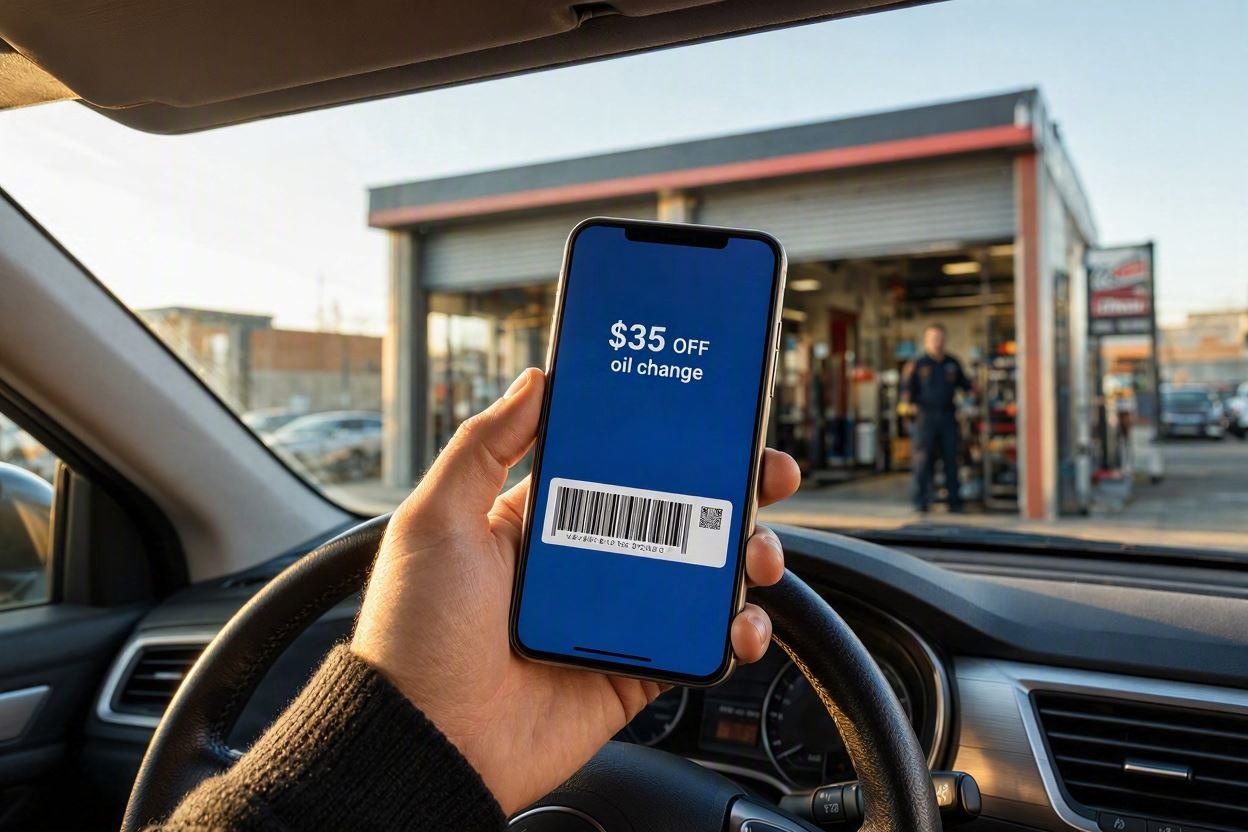
Never pay standard menu board prices at checkout. Shave $20 to $35 off your ticket by scanning an active jiffy lube coupon $30 off oil change price or claiming a verified valvoline instant oil change coupon directly from your phone.
How to Beat Counter Pricing and Lower Your Bill
You do not need to spend your weekend on a creeper underneath an engine bay to avoid inflated invoices. Keeping your routine car care within budget simply requires a strategic approach:
1. Verify Crankcase Capacity Ahead of Time: Check your vehicle owner's manual before visiting the shop. Knowing whether your engine requires 4.5, 6.0, or 8.0 quarts allows you to calculate potential quart overage charges before pulling into the service lane.
2. Decline Overpriced Waiting-Room Add-Ons: When an advisor approaches you with a dusty cabin air filter and quotes $50 to $70 for an instant replacement, decline politely: "Just the oil and filter change today, thanks." You can purchase the exact OEM-equivalent filter online for $15 to $20 and install it behind your glovebox in under five minutes without tools.
3. Target High-Value Synthetic Discounts: Quick-lube locations maintain healthy margins on lubricant packages, meaning regional offices consistently distribute verified vouchers to keep bay volume steady. If you prefer staying in your car, pull up an authentic take 5 oil change coupon $15 off before the advisor drafts the work order. For larger engines requiring full synthetic fluid, dollar-off barcode promotions effectively neutralize extra quart overage penalties.
If your vehicle is also due for tire rotation or suspension inspection, skip standalone quick-lube add-on rates. Dedicated full-service garages like Firestone Complete Auto Care and Midas routinely bundle tire rotations and brake evaluations directly into their routine service packages.
Compare Deals Across Nationwide Service Centers
Review regional rates and dodge unexpected counter fees by exploring verified oil change coupon specials across all major automotive repair chains.
Browse Verified OffersDetermining what does an oil change cost is not about hunting for questionable bargain-basement fluids that put your engine at risk. It is about matching your vehicle with the correct synthetic formulation, avoiding unneeded dealer markups, and applying verified promotional codes to keep your hard-earned cash where it belongs.