
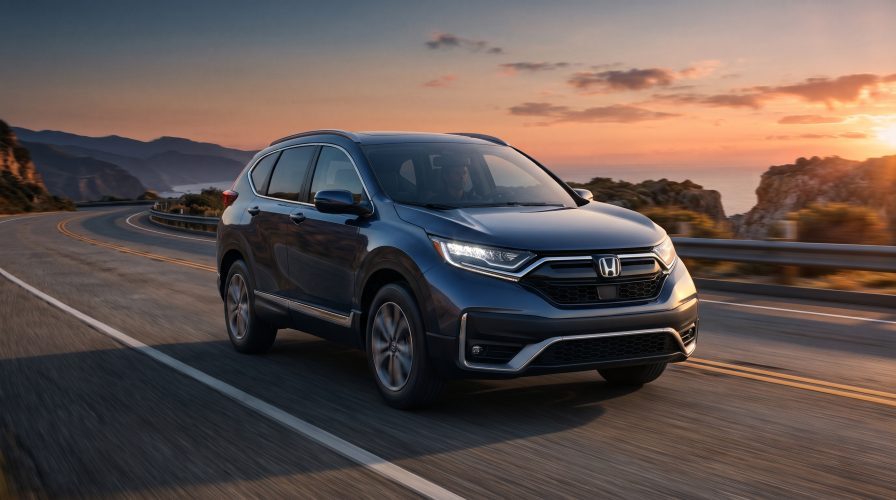
Walk onto a Honda lot looking for a sixth-generation CR-V, and you're stepping into the most competitive showroom battleground in America. A base front-wheel-drive CR-V LX starts at $29,705 including destination fees, while a loaded Sport Touring Hybrid pushes right up against $40,000. Add in dealer documentation fees, "mandatory" dealership paint protection packages, and regional market adjustments, and that sensible family crossover can easily cross $43,000 out the door.
For the past 25 years, the CR-V has been the default choice for private buyers who want a five-passenger SUV that just works. With the sixth-generation redesign (introduced for the 2023 model year), Honda ditched the awkward, egg-shaped styling of the past for a longer hood, a wider stance, and a wagon-like profile that actually looks like a grown-up SUV. It offers the interior passenger volume of a midsize sedan with triple the cargo capacity (39.3 cubic feet behind the second row).
If you're trying to figure out whether the CR-V is worth the sticker price—or if you should take your checkbook over to a Toyota, Mazda, or Subaru store—here is how the CR-V actually performs on the road, which trims are a waste of money, and what you need to watch out for before signing a buyer's order.
Quick Comparison: Honda CR-V vs. Top Rivals
| Model | Best For | Powertrain Highlight | Factory Warranty (Basic / Powertrain) | Biggest Catch |
|---|---|---|---|---|
| Honda CR-V (6th Gen) | Quiet, EV-like daily driving, huge cargo space, and foolproof interior controls | 4th-gen Hybrid (247 lb-ft torque, no traditional transmission) or 190-hp 1.5L Turbo | 3 yr/36,000 mi / 5 yr/60,000 mi (Includes 2 yrs free maintenance) | Hybrid models come with zero spare tire; no plug-in hybrid (PHEV) or off-road trim offered |
| Toyota RAV4 Hybrid | Maximum fuel economy and buyers who demand a factory spare tire | High-efficiency gas-electric hybrid; available Woodland Edition with all-terrain tires | 3 yr/36,000 mi / 5 yr/60,000 mi | Loud, coarse engine drone under acceleration; annoying subscription prompts on the nav screen |
| Mazda CX-5 Turbo | Drivers who want real back-road handling and punchy acceleration under $40K | Turbocharged 4-cylinder with heavy low-end torque and a real automatic gearbox | 3 yr/36,000 mi / 5 yr/60,000 mi | Tighter rear legroom and noticeably less cargo volume than the cavernous CR-V |
| Subaru Forester Wilderness | Deep snow, unpaved forest service roads, and brutal winter commutes | Standard symmetrical AWD, 9.3 inches of clearance, skid plates, and full-size spare | 3 yr/36,000 mi / 5 yr/60,000 mi | Slower highway passing power and less refined on-pavement manners than the Honda |
How the CR-V Actually Drives (And Why the Hybrid Wins)
The Secret Behind the 4th-Gen Hybrid: No Transmission
Honda sells the CR-V with two powertrains: a base 1.5-liter turbocharged four-cylinder making 190 horsepower (rated at 28 mpg city / 34 mpg highway) paired with a continuously variable transmission (CVT), and a fourth-generation two-motor hybrid system. Honda expects hybrids to account for fully half of all CR-V sales—and after driving both, the hybrid is the one you want in your driveway.
Why it feels so good: Here is a mechanical detail most dealership salespeople won't explain properly—the CR-V Hybrid doesn't have a conventional transmission. There is no CVT belt, no clunky planetary gears, and no dual-clutch gearbox. Instead, electric motors drive the wheels directly almost all the time, while the gas engine acts primarily as a generator (only coupling directly to the wheels during steady highway cruising). With 247 lb-ft of electric torque on tap right off the line, pulling into fast highway traffic is effortless. It drives with the smooth, instant response of a Chevy Bolt or Hyundai Kona EV, minus the charging headaches.
Honda also poured real engineering money into quieting the cabin. They added a secondary balancer to the crankshaft, fitted a urethane acoustic engine cover, and packed lightweight fiber-foam insulation into three key engine bay zones. Drive it like a normal adult, and you barely hear the gas engine kick on.
Interior & Tech: Buttons and Knobs Still Rule
While half the auto industry is busy burying simple climate controls inside laggy touchscreen menus to save five bucks per car on physical switches, Honda actually listened to drivers. The sixth-gen CR-V cabin gives you a real physical volume knob and dedicated, tactile buttons and dials for the heating and air conditioning.
Wireless Apple CarPlay and Android Auto connect without a hiccup, the sightlines are clean, and Honda stuck with a sensible standard moonroof rather than a massive panoramic glass roof that cooks the cabin in July and costs $3,000 to replace when a highway rock clips it.
Sizing Up the Rivals: When Should You Skip the CR-V?
As polished as the CR-V is, no car does everything. Depending on where you live and how you drive, three specific competitors beat the Honda at certain jobs:
- If you want a quieter cabin vs. raw MPG (CR-V Hybrid vs. Toyota RAV4 Hybrid): The RAV4 Hybrid edges out the Honda at the gas pump, and every RAV4 Hybrid comes with a spare tire in the trunk. However, the Toyota's gas engine groans loudly whenever you press the throttle, making it feel rough compared to the near-silent Honda. Even worse, Toyota's newer infotainment screens have a habit of flashing annoying pop-up ads trying to sell you a paid built-in navigation subscription when you start the car—an absurd cash grab when wireless Google Maps is free on your phone.
- If you actually care about cornering (CR-V vs. Mazda CX-5 Turbo): Honda calls its top $39,845 model the "Sport Touring," which is a bit of marketing comedy. It rides smoothly and never feels tippy, but it's no back-road weapon. If you want real steering feedback, sharp turn-in, and a gutsy turbo engine for under $40,000, go test-drive a Mazda CX-5 Turbo.
- If you drive in blizzards or dirt ruts (CR-V vs. Subaru Forester Wilderness): Honda doesn't build a rugged off-road trim for the CR-V. If your weekend involves muddy trailheads or unplowed mountain passes, the Subaru Forester Wilderness (or a Ford Bronco Sport Badlands) walks all over the Honda with 9.3 inches of ground clearance, factory skid plates, winter-rated all-terrain tires, and a full-size matching spare.
The Smart Buyer's Blueprint: How to Spec a CR-V and Save Thousands
Walk into a dealership without a specific trim in mind, and the finance manager will happily steer you straight into a $39,845 Sport Touring Hybrid or a $37,055 EX-L AWD. Here is how to get 95% of the top model's capability while keeping more than $4,000 in your bank account:
- Target the Sweet-Spot Trim (Sport Hybrid AWD): Skip the base gas LX ($29,705) and skip the pricey leather-lined EX-L ($35,210+ with AWD) and Sport Touring ($39,100–$39,845). Instead, order the CR-V Sport Hybrid with All-Wheel Drive ($33,900 base / $35,745 with destination and safety options). You get the exact same ultra-smooth hybrid powertrain as the $40K model, durable cloth seats that don't burn your legs in August or freeze in January, and a $4,100 discount right off the top.
- Pay the $550 for the Blind-Spot Package: On lower trims, Honda separated the Blind Spot Information (BSI) system and cross-traffic monitor into a $550 option package (bringing a front-wheel-drive Sport Hybrid from $32,400 to $32,950, or an AWD model from $33,900 to $34,450 before destination). Pay the $550. It prevents parking-lot fender benders and pays for itself the first time it saves you from an insurance deductible.
- Stick With the 18-Inch Wheels: The top-tier Sport Touring comes with flashy 19-inch wheels wrapped in thinner, low-profile rubber. The cheaper Sport Hybrid rides on 18-inch rims with taller sidewalls. Not only do 18-inch tires absorb potholes better and protect your rims from curb rash, they're also $40 to $60 cheaper per tire when it's time to buy replacements.
Insider Pro-Tip (The Missing Spare Tire Catch): If you buy the 1.5L turbo gas CR-V, Honda gives you a spare tire under the cargo floor. Buy any CR-V Hybrid, and that space is taken up by the hybrid battery pack—leaving you with nothing but a cheap tire-inflator repair kit. Shred a sidewall on a sharp pothole at 10 p.m. on a Sunday, and a sealant can won't save you. Right after buying a CR-V Hybrid, spend $200–$300 on a fitted compact spare tire kit and ratchet-strap it securely in the huge 39.3-cubic-foot cargo bay before taking a long road trip.
Safety, Warranties, and the Used CR-V Minefield
From a crash-protection standpoint, the sixth-gen CR-V is a tank. The Insurance Institute for Highway Safety (IIHS) awarded it their highest Top Safety Pick+ rating, acing even the brutal updated side-impact crash test. Furthermore, Honda's adaptive cruise control and lane-centering system work smoothly on the highway without phantom braking or constant false-positive warning beeps.
The Warranty Reality Check: Despite Honda's reputation for longevity (Consumer Reports predicts a strong 4-out-of-5 reliability score, and J.D. Power ranks Honda ahead of Acura, Mercedes-Benz, Tesla, and Audi in durability), Honda's factory warranty is stingy. You only get 3 years/36,000 miles of basic coverage and 5 years/60,000 miles on the powertrain—matching Toyota, Mazda, and Subaru, but trailing way behind Hyundai, Kia, and Mitsubishi. On the bright side, Honda now throws in two years of free factory scheduled maintenance (oil changes and tire rotations) on new models, so don't let the dealer trick you into paying for a prepaid oil-change package for the first 24 months.
Oil Change Maintenance: Don't Overpay Once the Freebie Runs Out
Whether you choose the 1.5L turbo or the 2.0L hybrid, both engines require full synthetic 0W-20 motor oil. Once Honda's two-year complimentary maintenance window expires, local dealerships will happily charge you $90 to $120 for a basic synthetic oil service and a multi-point "inspection" you didn't ask for. Don't fall for it. Keep your engine healthy—and prevent turbo wear—by sticking to strict 5,000- to 7,500-mile intervals rather than stretching the dashboard Maintenance Minder to 10,000 miles. Before you book your next service bay visit, use a proven oilchangehack to grab printable national lube-shop coupons and cut your synthetic oil change bill in half.
Shopping Used Instead? Watch the 2015–2018 Model Years
If new-car sticker shock has you browsing used CR-V listings, keep your guard up. While recent models have largely sorted out their mechanical bugs, older CR-Vs have two notorious weak spots you must inspect before handing over cash:
- Avoid 2015 and 2017 Models Without Service Records: Owner-reported defect data on CarComplaints earned both the 2015 and 2017 CR-V the dreaded "Beware of the Clunker" badge due to widespread engine and vibration complaints.
- Check for 1.5L Turbo "Oil Dilution": When Honda first introduced the small 1.5-liter turbocharged engine around 2017–2018, drivers in cold climates reported unburned gasoline seeping past the piston rings and diluting the engine oil. Before buying a used turbo CR-V, pull the dipstick and smell it—if the oil reeks of raw gasoline or sits way above the "full" mark, walk away. Also verify via the VIN that the 2021 CR-V Hybrid driveshaft recall and any software updates were completed by a certified Honda dealer.